Learn it or hire it
In house vs outsourced penetration testing: build it or buy it
In house vs outsourced penetration testing is the same choice this site is built around. You can learn it and staff it yourself, or you can hire it. However, most organizations end up with a mix, so the real question is which parts to keep inside.
- Authorisation before any test
- Plain-English guidance
- Written scope on every engagement
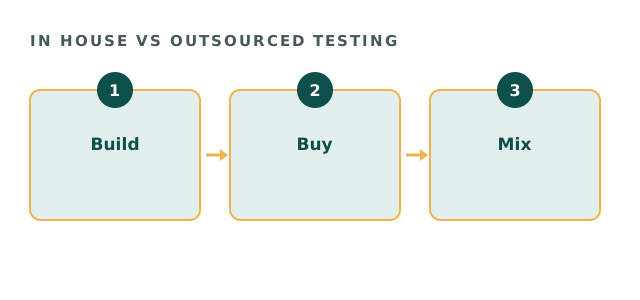
What in house vs outsourced penetration testing really compares
An internal team knows your systems and can test often. An outside firm brings independence and a fresh view. Each has costs that are easy to miss.
So compare the whole picture: people, training, tools, management time and the evidence each option produces.
The costs of each option
An internal team means salaries, ongoing training, tooling and someone to manage the work. It also means covering holidays and turnover. Meanwhile, an outside firm means a fixed fee per engagement and procurement time.
Because internal costs are spread across a year, they can look smaller than they are. Therefore add them up honestly before deciding.
| Factor | In house | Outsourced |
|---|---|---|
| Knowledge of your systems | Deep | Built during scoping |
| Independence | Limited | Strong |
| Frequency | As often as needed | Per engagement |
| Evidence for auditors | Sometimes questioned | Usually accepted |
| Management effort | Ongoing | Per engagement |
In house vs outsourced penetration testing questions to settle
Tick what you can already answer.
Your result appears here as you tick, so you can see what is still open.
Evidence: where in house vs outsourced penetration testing differs most
Many customers and auditors ask for an independent test. An internal team can be skilled, but it reports to the people it tests. As a result, its report may not satisfy an outside reviewer.
So even organizations with strong internal teams often buy one independent test a year for evidence.
When a mix works best
A common pattern is internal testing during development and an outside test before major releases or audits. Then each side does what it does best.
In addition, the outside firm can review how the internal team works. Because both reports exist, gaps become visible.
Deciding on in house vs outsourced penetration testing
Start with three questions. How often do you need testing? Who needs to see the evidence? And can you recruit and keep the right people?
If evidence is the main need and testing is yearly, outsourcing is usually simpler. If change is constant, an internal capability starts to pay for itself.
Hiring it from us
We take a limited number of engagements, with named senior practitioners and signed authorization before any testing. The method follows the Penetration Testing Execution Standard.
Full engagements run from $35,000 to $120,000, while the floor is $25,000. Also, the bounded External Attack Surface Review starts at $4,500. Moreover, its fee is credited in full against a full engagement commissioned within ninety days. Every fee is agreed in writing before anyone starts.
In house vs outsourced penetration testing FAQ
Is in house vs outsourced penetration testing an either-or choice?
No. Many organizations use internal testing day to day and an outside firm for evidence.
Will auditors accept internal tests?
Sometimes, but many prefer an independent party.
Which is cheaper?
It depends on frequency. Count every internal cost before comparing.
Can an outside firm support in house vs outsourced penetration testing decisions?
It can review how an internal team works, alongside its own test.
Related guides
Weigh in house vs outsourced penetration testing
Tell us how often you test and who needs the evidence. We reply in writing with a scope and a fixed fee for the outside part.
Ask about authorised testing