Plain English
Penetration test stakeholders, and what each one does
Penetration test stakeholders are the people on your side of the engagement. Each has a small, clear job. However, a missing stakeholder is the most common reason a test starts late or a report goes unread.
- Authorisation before any test
- Plain-English guidance
- Written scope on every engagement
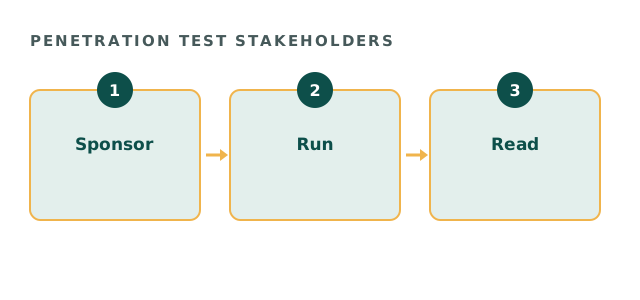
Why penetration test stakeholders matter
The testing firm does the testing. Everything else depends on your people: scope, approvals, access, contacts and fixes. So naming them early saves time later.
In addition, a named list stops sensitive findings from spreading. Because the report lists weaknesses, it should reach only the people who need it.
The core penetration test stakeholders
Most engagements need five roles. In a small organization, one person may hold two or three of them.
Write the list down, with a backup for each role. Then a holiday does not stop the work.
| Role | Main job |
|---|---|
| Executive sponsor | Approves the reason and budget |
| Security lead | Owns the project from brief to retest |
| System owners | Sign authorization and fix findings |
| Operations contact | Reachable during the testing window |
| Legal and procurement | Contract, NDA and purchase order |
Penetration test stakeholders list
Tick each role you have named, with a backup.
Your result appears here as you tick, so you can see what is still open.
Penetration test stakeholders during the window
During testing, one operations contact must be reachable at all agreed hours. If something unexpected happens, the firm pauses and reports to that person.
Also keep a short route to the security lead. Because serious issues are reported at once, someone must be ready to act.
Penetration test stakeholders after the report
The report has two audiences. Engineers need the findings and fixes. Executives need the summary and the business risk.
So plan two short sessions rather than one long one. As a result, each group hears what it needs.
Common gaps
The usual gap is a system owner who learns about the test late. Another is an operations contact who is not told the dates. Both are fixed by one message at the start.
Similarly, fixes stall when nobody owns them. Therefore every finding should end with a named owner and a date.
Working with us
We name the senior practitioner who will run the work, and we ask for your stakeholder list in the written scope. The owner signs authorization before any testing.
Full engagements run from $35,000 to $120,000, while the floor is $25,000. Also, the bounded External Attack Surface Review starts at $4,500. Moreover, its fee is credited in full against a full engagement commissioned within ninety days. Every fee is agreed in writing before anyone starts. The method follows the Penetration Testing Execution Standard.
Penetration test stakeholders questions
Who are the key penetration test stakeholders?
The sponsor, security lead, system owners, operations contact and legal.
Can one person hold several roles?
Yes, in a small organization. Name a backup anyway.
Who reads the report?
Engineers read the findings, and executives read the summary.
When should penetration test stakeholders be named?
In the written scope, before the testing window is fixed.
Related guides
Name your penetration test stakeholders first
Send your stakeholder list with a short brief. We reply with a written scope and a fixed fee.
Ask about authorised testing